Business funding in Egypt comes down to one question: which route can you actually get, and what will it cost you? The answer turns less on how strong your company is than on what your records can prove. A profitable business with informal bookkeeping gets refused. A smaller one with reconciled accounts and a clean tax history gets approved. Seven routes are realistically open to you. They differ in cost, in who qualifies, and in how much control you give up.
Key Takeaways
- ✓ Debt is usually cheaper than it looks; equity is more expensive. Selling 20% of a company that later grows tenfold costs far more than loan interest ever would.
- ✓ With two years of financial statements and collateral, start with a CBE-backed SME facility. It is normally the lowest-cost money in the market.
- ✓ Without trading history, bank lending is largely closed. MSMEDA programmes, asset-based leasing and angel investment are the realistic alternatives.
- ✓ Venture capital only fits businesses that can scale several times over. A steady, profitable company is a better fit for a bank.
- ✓ Most refusals come down to records, not performance — unreconciled accounts, or figures that don't match filed tax returns.
In This Article
- Debt or Equity: The Decision That Shapes Everything Else
- Commercial Bank Loans in Egypt
- CBE-Backed SME Finance
- Islamic Finance: Murabaha and Ijara
- MSMEDA and Government Programmes
- Development Finance: EBRD and IFC
- Angel Investors and Venture Capital
- Non-Dilutive Alternatives: Leasing, Factoring and Supplier Credit
- How to Choose: A Decision Framework
- What Lenders and Investors Actually Check
- Final Thoughts
- FAQs About Business Funding in Egypt
Debt or Equity: The Decision That Shapes Everything Else
Before comparing products, settle one question: are you borrowing money you must repay, or selling a share of your company? Cost, timeline and control all follow from that answer.
| Comparison Point | Debt | Equity |
|---|---|---|
| You repay | Principal plus interest, on a fixed schedule | Nothing — investors are paid through growth in value |
| You give up | Cash flow, and usually collateral | Ownership, and some control |
| Qualification rests on | Trading history, collateral, clean financials | Growth potential, market size, team |
| Typical timeline | Weeks to a few months | Three to nine months |
What each one really costs
Debt is repaid on schedule regardless of performance. A weak month does not pause the instalment — which is why lenders assess whether your existing cash flow can absorb the payment, not whether your plan is exciting. In exchange, all future growth stays with the current owners.
Equity carries no repayment. Investors are paid when the company becomes more valuable, so they need substantial growth, and a say in getting there.
The arithmetic deserves care. Three rounds diluting 20%, 20% and 15% leave founders roughly 54%, not the 45% simple subtraction suggests — each round dilutes proportionally, not absolutely. But percentage is not economics. Option pools usually form before a round and dilute founders alone, and liquidation preferences can pay a 20% holder considerably more than 20% of an exit. Model the cap table before signing the first term sheet, with financial advisory support if the structure is unfamiliar.
Which applies to you
An established business with two or three years of accounts and steady cash flow should exhaust debt first. A company without trading history or collateral usually has no realistic option but equity. Regionally, debt is gaining ground: Wamda reported MENA startups raised $454.7 million in May 2026, led by debt financing.
Commercial Bank Loans in Egypt
Bank lending is the largest source of formal business finance in Egypt and, for a profitable company with two or three years of accounts, usually the cheapest. The sector comprises 40 banks under Central Bank supervision, and the National Bank of Egypt, Banque Misr and Banque du Caire — all state-owned — account for roughly 40% of it.
What banks require
- Trading history. A minimum operating period, which rules out most pre-revenue businesses.
- Financial statements for the last two to three years — audited above a certain facility size.
- Tax compliance. Filed returns and settled liabilities. Resolve your tax position before applying, not during.
- Collateral. Property, equipment, receivables, or a personal guarantee from the owner.
- Repayment capacity. Operating cash flow that comfortably covers the instalment — not cash flow that just about covers it.
Documents to prepare before you apply
- Commercial register and tax card
- Financial statements, last two to three years
- Recent bank statements
- Filed tax returns and tax clearance
- Business plan with financial projections
- Collateral documentation
- Shareholder identity and ownership records
Meeting the criteria makes you eligible, not approved. Credit committees also weigh your sector, the length of your banking relationship, and the quality of the file itself. A complete, reconciled application from a business the bank already understands moves faster than a stronger business with gaps in its records — and the file is the part you control.
CBE-Backed SME Finance
Not every bank loan is priced the same. Alongside their own products, Egyptian banks distribute subsidised credit lines created by the Central Bank to widen SME access to finance. Same lender, same branch, different pricing — and a subsidised line is by definition cheaper than the bank's standard commercial terms. Establish whether you qualify before you accept a commercial rate.
How it reaches you
The Central Bank is a regulator, not a lender. Subsidised lines are delivered through commercial banks, and three consequences follow. The bank assesses your eligibility, not the regulator. The bank holds the allocation, so availability depends on that institution rather than the programme in general. And the programme's terms set the price — this is not a rate you negotiate. Ask for those terms in writing.
What to ask your bank
- Is the CBE-backed SME line currently available here, and is the allocation still open?
- Which turnover band do we fall into, and what rate applies to it?
- Is the rate fixed for the full term, or does it reset?
- Are there restrictions on how the funds may be used?
- What is the total cost including arrangement and administrative fees, not the headline rate alone?
- If we sit outside the band, is there another line we qualify for?
Programme scope, eligibility bands and pricing are revised periodically. Confirm the current position with the Central Bank of Egypt and with the bank itself before building a plan around a rate. Where the answers differ, an eligibility review costs less than a rejected application.
Islamic Finance: Murabaha and Ijara
Sharia-compliant business finance is well established in Egypt. Faisal Islamic Bank of Egypt was the country's first Islamic commercial bank, founded under Law 48 of 1977. Al Baraka Bank Egypt and ADIB Egypt both run dedicated arms for small and medium enterprises.
| Comparison Point | Murabaha | Ijara |
|---|---|---|
| How it works | The bank buys the asset, then sells it to you at an agreed mark-up | The bank buys the asset and rents it to you |
| Who owns it | You own it straight away | The bank owns it during the term |
| What you pay | Fixed instalments that add up to the agreed price | Regular rent |
| Best suited to | Inventory, raw materials, equipment | Property, machinery, vehicles |
| At the end of the term | Nothing transfers — the asset is already yours | Ownership passes to you if the lease is written to end in ownership |
What the terms look like
Faisal Islamic Bank of Egypt publishes terms for a solar power Murabaha aimed at companies: up to EGP 10 million, covering as much as 75% of the installation cost, repaid over up to seven years. The administrative fee is 0.25% of the amount financed, charged once for the whole term. The bank also asks for a certificate from a chartered accountant confirming the business has no outstanding tax or social insurance dues.
You still qualify for the subsidised rate
Choosing Sharia-compliant finance does not exclude you from the Central Bank's SME initiative. Al Baraka Bank Egypt states that it applies the initiative at return rates of 5% and 8% for companies with annual revenues between EGP 1 million and EGP 200 million, and competitive rates for activities outside it. These rates and revenue bands change, and they vary between banks, so confirm them before comparing offers.
Ijara or a conventional lease?
Ijara is a lease, so how does it differ from the leasing companies covered later? The difference is the provider. Ijara comes from the bank. Conventional financial leasing comes from a company licensed by the Financial Regulatory Authority, and ADIB Egypt offers leasing through a separate subsidiary rather than through the bank itself. The economics are similar, so price both.
MSMEDA and Government Programmes
The Micro, Small and Medium Enterprise Development Agency is the government body responsible for supporting Egypt's smaller businesses. It lends directly and through partner institutions, and it is often the realistic route for a company that cannot yet meet a commercial bank's requirements on trading history or collateral.
Support is not only money
Government programmes usually combine finance with technical assistance: training, marketing support, help with licensing, and access to markets. It is worth asking what non-financial support comes attached to a facility, because it is rarely advertised as prominently as the funding itself.
The part most funding guides miss
Government support for Egyptian businesses is not only credit. Law 152 of 2020 on the development of micro, small and medium enterprises introduced a simplified tax regime alongside a set of exemptions, and two of them bear directly on the cost of borrowing. Contracts for credit facilities, and the mortgage or pledge contracts securing them, are exempt from stamp duty and notarisation fees for five years from entry in the commercial registry, with MSMEDA issuing the certificate of entitlement. The law also exempts capital gains on the sale of machinery or production equipment where the proceeds are reinvested in new equipment within a year, conditional on keeping regular books and accounts. Money you do not pay is cheaper than money you borrow, and eligibility turns on how the business is registered and how its tax position is managed.
Where to look
Programme names, loan ceilings and eligibility criteria change, and several government schemes run alongside donor-funded ones. The Ministry of International Cooperation operates HAFIZ, a platform bringing together financing and business support offered through Egypt's development partners, with a tool that matches a business to the options it may qualify for. Start there, then confirm the detail with MSMEDA or the relevant institution directly. Check as well whether your governorate or sector has a dedicated programme, since some are geographically or industrially targeted.
Development Finance: EBRD and IFC
International development institutions are among the largest sources of business finance in Egypt, but you cannot borrow from them directly. The EBRD has committed €14.6 billion across 227 projects since Egypt became a recipient country in October 2015, and the IFC has invested and mobilised close to $10 billion. Almost none of it reaches a smaller business as a direct loan. It arrives as credit lines and risk-sharing facilities placed with Egyptian banks and finance companies, which then on-lend it.
What that looks like in practice
In February 2026 the IFC announced a $150 million investment with Banque Misr to scale green finance and expand lending to micro, small and medium enterprises, with 20% of that lending allocated to women-owned businesses. A separate $30 million partnership with Global Corp, a non-bank financial platform, was directed at leasing and factoring for smaller companies. The EBRD approved its own SME loan facility with Global Corp in June 2026. In every case, the institution a business actually deals with is Egyptian.
Green lending is where the money is concentrated
More than half of the EBRD's investment volume in Egypt went to green financing in 2025. The Central Bank has built a framework around it: its Governor has described issuing Sustainable Finance Guiding Principles in 2021, Sustainable Finance Binding Regulations in 2022, and Carbon Border Adjustment Mechanism reporting requirements in 2025. The EBRD's Green Economy Financing Facility lends through participating Egyptian banks for energy efficiency and renewable investments, so a business replacing machinery with a more efficient model may qualify for terms it would not get on a standard facility.
How to find it
Ask your bank which development credit lines it currently carries, and for what purposes. Terms attached to donor-backed money are often better than the bank's own products, and the question is not always volunteered. HAFIZ lists what is currently open.
Angel Investors and Venture Capital
Equity suits a narrow band of companies: those targeting rapid growth, usually in technology or scalable services, with a credible route to a large market. It is the wrong instrument for a steady, profitable business that needs working capital, and pursuing it wastes months that a bank facility would have taken weeks.
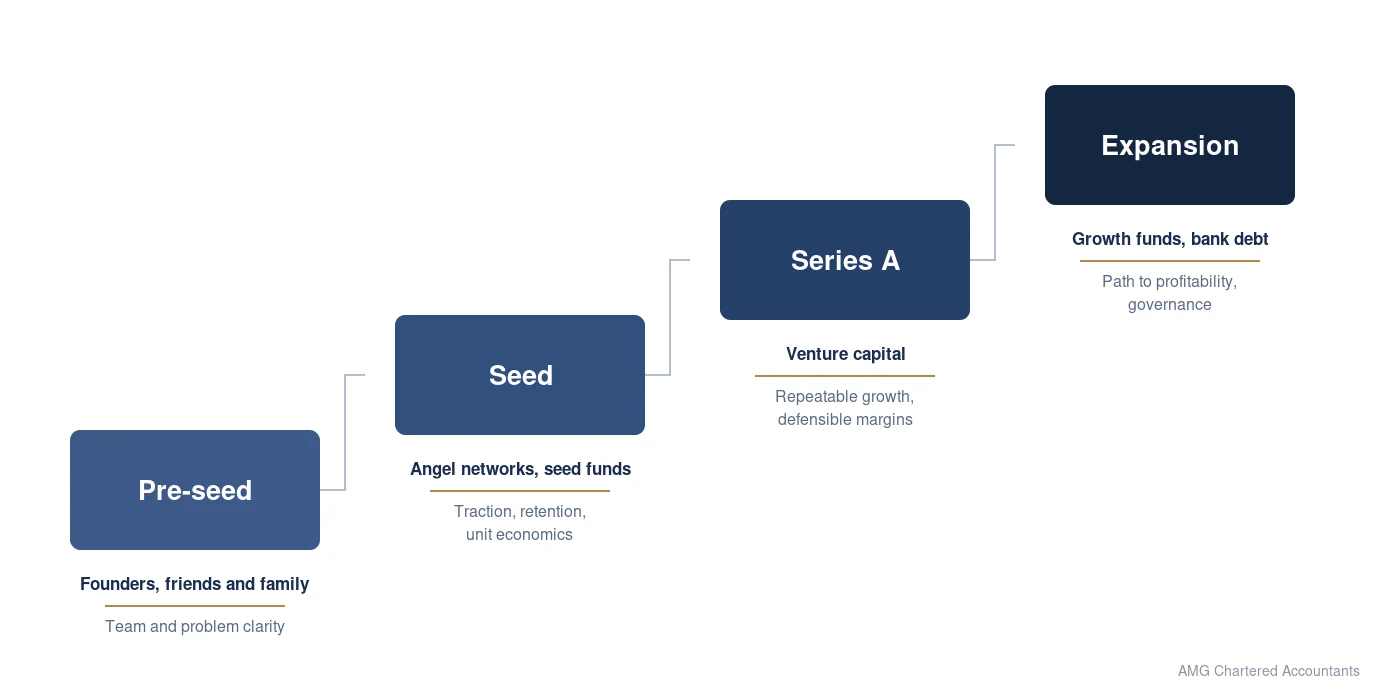
| Stage | What it funds | What investors weigh most |
|---|---|---|
| Pre-seed | Building the product, first hires | The founding team, and how clearly the problem is defined |
| Seed | Finding product-market fit | Early traction, customer retention, unit economics |
| Series A | Scaling what already works | Repeatable growth and defensible margins |
| Growth | Market expansion | A path to profitability, and governance |
The market you are raising in
Regional volumes give a sense of scale. Wamda reported that startups across the Middle East and North Africa raised $1.7 billion in the first half of 2026, with Egypt taking a share of that alongside considerably larger Gulf markets. Monthly figures move sharply, so a quiet quarter is not a signal about your business.
Where to look
Egypt has an established ecosystem of accelerators, angel networks and institutional funds, and the practical difficulty is knowing which are deploying now rather than which existed two years ago. The Ministry of International Cooperation's HAFIZ platform maintains a financing directory and a matchmaking tool, which is a better starting point than any list fixed at the date of publication.
Non-Dilutive Alternatives: Leasing, Factoring and Supplier Credit
Between a bank facility and selling equity sits a set of options Egyptian businesses routinely overlook. They are generally faster to arrange and easier to qualify for, because the security is an asset or a receivable rather than your trading history.
Leasing
GlobalCorp, a licensed Egyptian financing company backed by both the IFC and the EBRD, describes leasing as rentals over three to seven years ending in full ownership, covering real estate, vehicles, machinery and production lines. Three structures are worth knowing:
- Direct lease. The lessor buys the asset you need and leases it to you.
- Operating lease. Use of an asset for less than 75% of its economic life without owning it — suited to equipment you replace on a cycle.
- Sale and leaseback. You sell machinery or premises you already own to the lessor and lease them back, converting a fixed asset into working capital.
The third is the one most owners have never considered. It raises cash without new borrowing, though it changes how the asset sits in your accounts and carries tax consequences worth modelling before you commit.
Factoring
If you sell to corporate or government customers on extended payment terms, you can sell those receivables for immediate cash at a discount. More expensive than a bank facility, and considerably cheaper than running out of cash.
Supplier credit
The cheapest funding available, and the most ignored. Negotiating 60-day terms with suppliers while collecting from customers in 30 finances your working capital at no cost. Before applying for anything, look at your working capital cycle — a business seeking a loan sometimes has a collections problem instead.
Before you sign
Leasing and factoring companies are licensed by the Financial Regulatory Authority, which publishes a register of licensed financing companies. Check any provider against it. Egypt's movable collateral framework also allows equipment and receivables to be pledged rather than only property, which is what makes several of these routes available to a business that does not own its premises.
How to Choose: A Decision Framework
Start with what the money is for. That question alone eliminates most of the seven routes before you examine any of them closely.
| What the money is for | Where to look first | Why |
|---|---|---|
| Equipment or vehicles | Leasing, or Murabaha | The asset is the security, so the qualification bar is lower |
| A working capital gap | Overdraft, factoring, supplier terms | Faster than a term loan, and matched to the trading cycle |
| Inventory for a confirmed order | Trade finance, or a short-term facility | Repayment comes from the order itself |
| Opening a second location | A CBE-backed term facility | The cheapest money available if you qualify |
| Energy-efficient equipment | A GEFF-participating bank, or solar Murabaha | Development-backed terms can beat a standard facility |
| Building a product before revenue | Angel investment, or an accelerator | There is no trading history to lend against |
| Rapid market expansion | Venture capital | Only where the business can grow several times over |
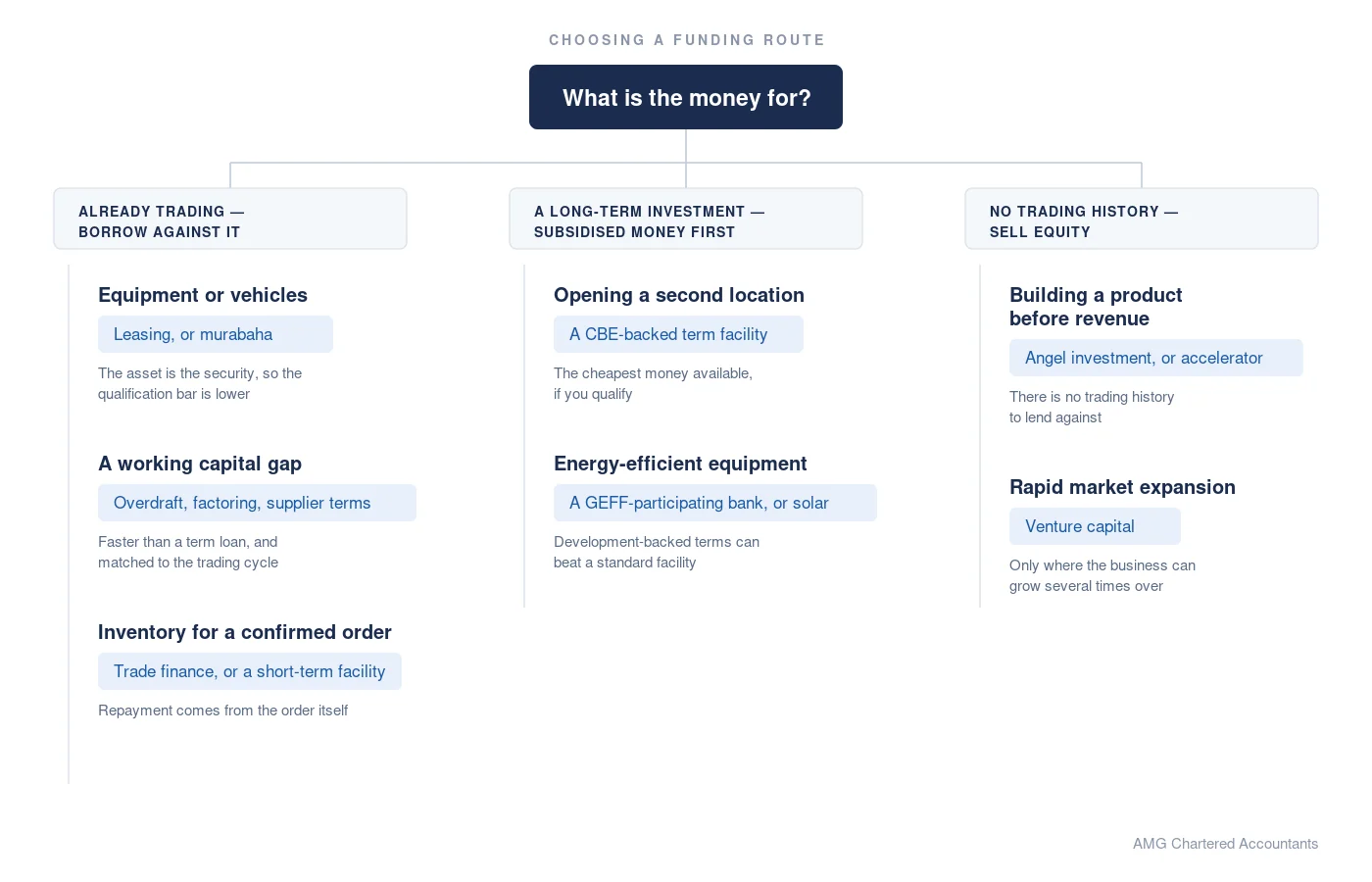
Two constraints then do most of the eliminating. Without two or more years of financial statements, bank facilities and CBE-backed lines are largely closed. Unwilling to give up ownership, and every equity route closes. What remains is a question of price and timing.
If two routes survive, price both. If none survive, the answer is rarely a different lender — it is a stronger set of accounts, which is what a funding readiness review is for.
What Lenders and Investors Actually Check
Lenders and investors assess a file, not a business. The documents in it have to agree with one another, stand up to a tax check, and survive questions the owner has usually not been asked before.
Whether the numbers agree
A reviewer normally sees three sets of figures — management accounts, audited financial statements, and filed tax returns. Where the three reconcile, each corroborates the others. Where they do not, none of them can be relied on, and the difficulty is no longer the discrepancy itself but the question it raises about everything else in the file. Reconciling them is bookkeeping work, and it takes longer than the application does.
The certificate you may not know you need
Faisal Islamic Bank of Egypt's corporate murabaha requires a certificate from a chartered accountant confirming the business has no outstanding tax or social insurance dues. Law 152 of 2020 conditions its capital gains relief on the business keeping regular books and accounts. In both cases an accountant's work is a condition of access rather than a formality, and neither can be produced retrospectively in a week.
Tax and social insurance standing
Unfiled returns or unsettled liabilities with the Egyptian Tax Authority will stall a bank application and will surface in any investor's due diligence. Informal payroll arrangements create unrecorded social insurance obligations, which appear in diligence as a contingent liability and reduce what an investor is prepared to pay.
What investors examine that lenders do not
Equity due diligence covers the same financial ground, then adds the share register, the cap table, related-party transactions and the basis of your projections. A lender can be satisfied by security. An investor cannot, because their return depends on the numbers being accurate rather than merely covered.
The work that determines the outcome is done before the application, not during it.
Final Thoughts
There is no single best route. A profitable manufacturer with property to pledge should be looking at a CBE-backed facility. A pre-revenue software company should be talking to angels. A distributor waiting ninety days for payment may not need funding at all — it may need to collect faster.
What the successful applications have in common is that the preparation came first: accurate accounts, a clean tax position, projections that can be defended line by line, and a clear answer to what the money is for and how it will be repaid. Those are accounting questions before they are financing questions.
AMG has advised Egyptian businesses on accounting, audit and tax since 1995. A funding readiness review tells you which routes are open to you, and what needs fixing first.
Book a Funding Readiness ReviewFAQs About Business Funding in Egypt
What is the easiest business funding to get in Egypt?
Asset-backed finance is generally the most accessible, because the asset itself provides the security rather than your trading history. Leasing and murabaha for equipment or vehicles carry lower qualification barriers than unsecured lending. A business without collateral or trading history will usually find MSMEDA programmes or angel investment more realistic.
Can a startup get a bank loan in Egypt?
It is difficult. Egyptian banks generally require a minimum trading period and two to three years of financial statements before extending a business facility, which excludes most pre-revenue companies. Founders in that position usually pursue angel investment, accelerators, MSMEDA programmes, or leasing against a specific asset instead.
What documents do I need for a business loan in Egypt?
Typically a commercial register and tax card, financial statements for the last two to three years, recent bank statements, filed tax returns and clearance, a business plan with projections, collateral documentation, and shareholder records. Some banks also require a certificate from a chartered accountant confirming no outstanding tax or social insurance dues.
What rate does the CBE SME initiative offer?
Rates are set by the programme rather than negotiated, and they differ between banks. Al Baraka Bank Egypt publishes return rates of 5% and 8% for companies with annual revenues between EGP 1 million and EGP 200 million. Confirm current rates and bands with your bank, since both are revised periodically.
Is Islamic finance cheaper than conventional lending in Egypt?
Generally no. Mark-ups on murabaha and rentals on ijara are priced against prevailing market conditions, so the commercial cost sits close to conventional lending. What differs is the structure: the price is fixed and disclosed at signing, and the bank takes ownership of a real asset during the transaction.
How long does business funding take in Egypt?
A bank facility with complete documentation usually takes several weeks to a few months. Government and development-backed programmes often take longer. Equity rounds typically run three to nine months from first meeting to funds received. Unreconciled financial records add to that timeline, because they must be corrected before the file can be assessed.
Can I get funding if I have outstanding tax issues?
It is unlikely from a formal lender. Banks check tax compliance during assessment, and unfiled returns or unsettled liabilities will normally stop an application. Investors find the same issues in due diligence. Resolving your position with the Egyptian Tax Authority before applying is faster than attempting both at once.
Are there tax incentives for small businesses in Egypt?
Yes. Law 152 of 2020 introduced a simplified tax regime for micro, small and medium enterprises, together with exemptions from stamp duty and notarisation fees on credit facility and mortgage contracts for five years from commercial registration. Terms are revised, so confirm the current position before relying on them.
Tags
RELATED ARTICLES

How to Manage Your Finances in the First Year of a Startup Oct 21, 2024
Business Loans in Egypt: SME, Startup & MSME Options Aug 15, 2025